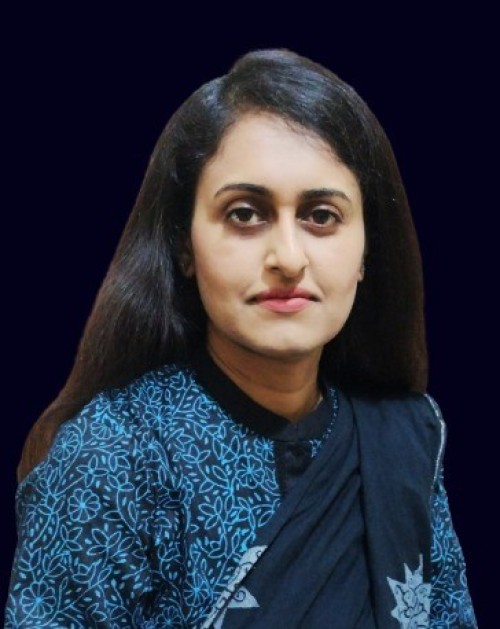
Ms. Tasnim Ferdous
Senior Lecturer
tasnim.ferdous@bracu.ac.bd
Address
CSE Department
4th floor, Room No # 4K73,
Brac University,
Kha 224 Bir Uttam Rafiqul Islam Avenue,
Merul Badda, Dhaka, Bangladesh
Tasnim Ferdous is a Senior Lecturer in the Department of Computer Science and Engineering at BRAC University. She earned her M.Eng. in Electrical and Computer Engineering from Oregon State University (2016), where she received the Laurel Award, and her B.Sc. in Electrical and Electronic Engineering from American International University-Bangladesh (AIUB) in 2012.
Her research in computational cognitive neuroscience focuses on learning and memory across wakefulness and sleep. She combines adaptive cognitive training, physiological signal analysis, and interpretable AI. Her interests include personalized working-memory training, the Method of Loci, mental imagery, and VR-based route navigation.
Her sleep research builds on published work in EEG- and PPG-based sleep-stage classification and explores how AI can help interpret and predict brain activity during sleep. Targeted memory reactivation (TMR) is an exploratory interest for future research, investigating whether cues during sleep, linked to earlier learning, can support memory consolidation and later recall.
She supervises undergraduate research in sleep analysis, assistive human–computer interaction (HCI), and applied computer vision. Previously, she taught at Northern University Bangladesh and completed an electrical engineering internship at Electro Scientific Industries (ESI) in the United States.
Outside academia, she enjoys sketching, reading across a variety of topics, hiking, and experimenting with new recipes.
ACADEMIC APPOINTMENTS
1. Senior Lecturer / Lecturer-I - BRAC University, Bangladesh | June 2022- Present
2. Lecturer - Northern University, Bangladesh | April 2021- May 2022
3. Electrical Engineer (Intern) - Electro Scientific Industries, USA | Jun 2015- Aug 2015
4. Graduate Teaching Assistant - Oregon State University, USA | December 2013- December 2014
PROFESSIONAL SERVICE
I work at the intersection of assistive human–computer interaction (HCI) and computational cognitive neuroscience. I explore how technology can support human cognition, improve learning and memory, and make digital experiences more accessible.
My research spans several areas:
1. Immersive VR & Spatial Memory: Creating immersive experiences in 2D games to support spatial learning and Method-of-Loci training.
2. Adaptive Cognitive Training: Developing personalized systems that adapt to users' performance and support the development of expert memory skills.
3. Sleep & Memory Neuroscience: Investigating how sleep supports memory consolidation using EEG analysis and computational modeling.
4. Interpretable AI & Physiological Signal Analysis: Developing explainable machine-learning approaches to understand and predict patterns in brain signals.
5. Assistive HCI & Accessible Technologies: Designing interactive systems that improve accessibility and adapt to human needs.
My broader goal is to bridge human-centered computing and cognitive neuroscience to develop intelligent, accessible, and personalized technologies that enhance learning, memory, and human capabilities.
Student Thesis Opportunities-
I welcome inquiries from motivated undergraduate and master’s students from BRAC University, interested in
1) VR-enhanced Desktop learning environments,
2) Brain-Computer Interface (Theta Neurofeedback) and
3) assistive human–computer interaction (HCI), and applied computer vision - GestureBraille.
Projects involve experimental design, data collection and analysis, computational modeling, or interactive system development. To express interest, email (tasnim.ferdous@bracu.ac.bd) your CV and a short description of the project or research area you would like to explore.
I mentor undergraduate researchers in study design, model development, experimental evaluation, result analysis, and manuscript preparation. The projects below include supervised research and my own work on adaptive interaction.
This project investigates how EEG sleep-stage classifiers generalize across datasets. We are examining transfer learning approaches to improve classification under dataset shift, with an emphasis on Macro-F1 performance and adaptation to new data with limited training.
Team: Tasnim Ferdous and Naveed Mahmood.
We developed GradG-AttnSleep, an interpretable sleep-staging framework built on an attention-based CNN. The work applies dual-mode Grad-CAM to examine the EEG patterns contributing to model decisions and support physiologically oriented interpretation of predicted sleep stages.
Team: Tasnim Ferdous, Naveed Mahmood, and Aniqua Nusrat Zereen.
3. Explainable PPG Sleep Stage Classification | Completed with two IEEE conference publications in 2024
This work investigated machine learning and explainable AI for sleep-stage classification from photoplethysmography (PPG). I served as first author on two papers and co-supervised undergraduate teams examining classification approaches and informative physiological features.
Team: Tasnim Ferdous, Aniqua Nusrat Zereen, Reshad Ul Karim, Abrar Samin, Sammam Mahdi, and Himika Tasnim.
Publications:
• N. S. Mahmud, T. Ferdous, and A. N. Zereen. “GradG-AttnSleep: Dual-Mode GradCAM for Interpretable Sleep Staging with an Attention-Based CNN.” Proceedings of the 17th International Conference on Information Technology and Electrical Engineering (ICITEE 2025), Bangkok, Thailand, 2025.
• T. Ferdous, R. U. Karim, A. Samin, S. Mahdi, and A. N. Zereen. “Improved Photoplethysmography-Based Four-Stage Sleep Classification with Explainable AI-Driven Machine Learning,” 2024 IEEE 2nd International Conference on Electrical, Automation and Computer Engineering (ICEACE), Changchun, China, 2024, pp. 117-122.
• T. Ferdous, R. U. Karim, A. Samin, S. Mahdi, H. Tasnim, and A. N. Zereen. “Machine Learning Approaches in Photoplethysmography-Based Sleep Stage Classification,” 2024 IEEE 2nd International Conference on Electrical, Automation and Computer Engineering (ICEACE), Changchun, China, 2024, pp. 123-128.
This project asks whether gameplay behavior can guide personalized difficulty regulation in active-recall working-memory tasks. Developed a sensor-free controller that uses accuracy, relative reaction time, omissions, repeated errors, and fatigue-related slowing to adjust task difficulty. A five-day study with 81 participants evaluated its ability to provide individualized, behavior-responsive adaptation.
Conceptualized and supervising GestureBraille, a computer vision-based assistive input system designed to support symbolic text entry for visually impaired users. The system translates hand gestures into Braille-cell six-dot selections.
Team: Mostakim Mahmud Mugdhha, Dr. Farida Chowdhury and Tasnim Ferdous.
This project develops a real-time drowsiness detection system for classroom and driver-monitoring settings. It combines MediaPipe-based region extraction, deep learning, Grad-CAM interpretation, and temporal smoothing. Evaluation examines performance under varied lighting and motion conditions.
Publications:
• M. M. Mugdhha and T. Ferdous. “Learned Residual Refinement of Deterministic Landmark-Based ROIs for Reducing Boundary-Associated Crop Risk.” Proceedings of the 18th International Conference on Intelligent Human-Computer Interaction (IHCI 2026), Ningbo, China, 2026. Accepted for publication.
| Research Subfield | Recommended Conferences (Highest to Lowest Priority) |
|---|---|
| Immersive VR & Spatial Memory | IEEE VR → ACM CHI → ACM UIST |
| Assistive HCI & Accessible Technologies | ACM ASSETS → ACM CHI → ACM ICMI |
| Sleep-Dependent Memory Consolidation & Sleep EEG | SLEEP → IEEE BHI → IEEE EMBC → OHBM |
| Computational Cognitive Neuroscience & Memory Modeling | CCN → ACM CHI → CNS |
| Adaptive Cognitive Training & Personalized Learning | ACM CHI → CCN → ACM UIST |
| Interpretable Machine Learning & Computational Modeling | ICLR → NeurIPS → ICML |
| EEG & Physiological Signal Analysis | IEEE BHI → IEEE EMBC → OHBM |
| Multimodal Interaction & Gesture-Based Systems | ACM ICMI → ACM CHI → ACM ASSETS |
| Computer Vision & Visual Understanding | CVPR → ICCV → ACM Multimedia |
| Multimedia Retrieval & Scene Understanding | ACM ICMR → ACM Multimedia → CVPR |
*Rankings reflect approximate relevance to each research subfield. Actual suitability depends on the paper's contribution, methodology, and evaluation.
Accepting
As: |
Supervisor |
Level: |
Undergraduate & Postgraduate |
Type: |
|
check the Synopsys for details